
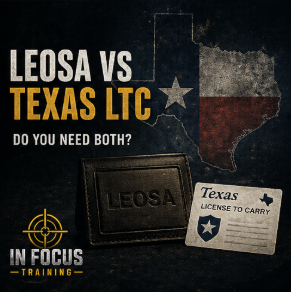
LEOSA vs Texas LTC: Do Retired Officers Need both?
April 25, 2026 5:18 pmWhat Counts as LEOSA Qualification Texas Requirements?
Retired officers often ask a practical question: “If I qualify under LEOSA, do I still need a Texas License to Carry?”
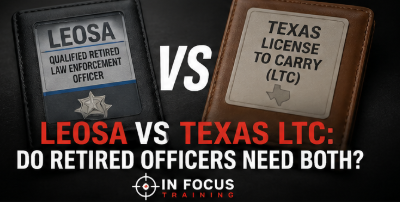
That question makes sense. LEOSA gives qualified retired law enforcement officers a powerful carry pathway. Under federal law, a qualified retired law enforcement officer who carries the required identification may carry a concealed firearm across state lines, subject to specific limitations. That authority comes from 18 U.S.C. § 926C, which covers qualified retired law enforcement officers.
A Texas LTC operates differently. It is a state-issued license. It applies under Texas law and works through state recognition and reciprocity structures. LEOSA and the Texas LTC are not the same thing, and they do not solve the same problems in the same way.
The cleanest way to understand the difference is this: LEOSA is built around your status as a qualified retired law enforcement officer. A Texas LTC is built around your status as a licensed civilian carrier under Texas law.
That difference matters.
What LEOSA Gives Retired Officers
LEOSA gives qualified retired officers national reach. It can allow lawful concealed carry in places where a regular state permit may not be recognized. For a retired officer who travels, this is a major benefit. You do not have to study every reciprocity map the way a civilian permit holder does.
But LEOSA still has conditions. You must meet the qualified retired officer criteria. You must carry the required identification. You must maintain current firearms qualification documentation. The annual qualification piece is not optional. It is central to staying covered.
LEOSA also has limits. Federal law does not wipe out every restriction everywhere. Private property rules can still matter. Federal facility restrictions still matter. State and local restrictions tied to certain government properties can still create issues. That is why retired officers need to understand not only the benefit, but the boundary.
If you need a qualification process in Texas, this is where your service page should come in naturally:
Internal link: Complete your annual qualification here: /leosa-qualification-texas
What a Texas LTC Gives You
A Texas LTC gives you clean, local recognition. For many retired officers, that matters because most everyday encounters happen locally. Traffic stops, range visits, private training, firearm purchases, and general carry interactions may go smoother when you have a Texas-issued LTC.
The LTC can also help in situations where someone reviewing your credentials does not understand LEOSA well. That does not mean the LTC is “stronger” than LEOSA. It means the LTC is familiar. Local officers, ranges, and some businesses understand the Texas LTC framework quickly.
Texas DPS also maintains specific law enforcement special condition guidance for handgun licensing, including retired peace officers and retired federal officers. That matters because Texas treats certain law enforcement categories differently in licensing and documentation contexts.
So while LEOSA may provide national carry authority, an LTC may still provide practical convenience.
Why Some Retired Officers Carry Both
Some retired officers maintain both LEOSA qualification and a Texas LTC because they want layers. That is not a bad strategy.
LEOSA may help when traveling across state lines. The LTC may help in local recognition and standard Texas carry situations. Having both can reduce confusion, especially when dealing with people who do not understand LEOSA.
Think about it like this: LEOSA answers the national carry question. The Texas LTC answers the familiar state credential question.
For some people, LEOSA alone is enough. For others, having both makes life easier.
The right answer depends on how often you travel, where you carry, how much you want to simplify interactions, and whether you want the added convenience of a Texas-issued license.
Real-Life Scenario
Say you are a retired federal officer living in Texas. You drive to Louisiana, then Mississippi, then Florida to visit family. LEOSA may give you the nationwide carry pathway you need, assuming you meet all requirements and remain current.
Now imagine you are back in Texas, pulled over during a routine traffic stop. You have your retired credentials and qualification documentation, but the officer is more familiar with the Texas LTC than LEOSA documentation. You may be legally fine under LEOSA, but the conversation could take longer.
That is where an LTC can reduce friction.
The point is not fear. The point is simplicity.
What In Focus Training Can Support
In Focus Training can help with the qualification side by providing a structured LEOSA qualification session. The goal is simple: help qualified retired officers complete their annual firearms qualification in a professional setting.
This does not replace your responsibility to understand your eligibility. It does not issue LEOSA credentials. It does not turn LEOSA into an LTC. It supports the qualification requirement so you can maintain current documentation.
For retired officers who also want a Texas LTC, In Focus Training can support that path as well through existing LTC instruction and range proficiency services.
Bottom Line
LEOSA and Texas LTC are different tools.
LEOSA gives qualified retired officers a federal carry pathway across state lines. Texas LTC gives a state-recognized license that may simplify local interactions and provide additional convenience.
You may not need both. But many retired officers choose both because it gives them flexibility, clarity, and fewer headaches.
If your LEOSA qualification is due, handle that first. Current qualification is the foundation. Then decide whether a Texas LTC adds value based on how you actually carry, travel, and interact day to day.
Professional LEOSA qualification in Texas:
Scheduling
Related LEOSA Resources
- Where You Can and Cannot Carry Under LEOSA
- What LEOSA Qualification Really Looks Like
- LEOSA vs Texas LTC: Do Retired Officers Need Both?
- Traveling with LEOSA: What Retired Officers Should Know Before They Go
- The Responsibility of Carrying Under LEOSA After Retirement
Satisfied Customer
“As a retired officer, I appreciated the no-nonsense approach. Clear expectations, solid instruction, and I walked out with everything I needed.”
Stay Current. Stay Covered.
If your LEOSA qualification isn’t current, handle it now.
👉 Schedule your LEOSA qualification in Texas:
Schedule